
Natalie Sleeth's Journey to "Hymn of Promise"
Writing What Is Worth Singing

United Methodists have been formed in our faith by many traditions and leaders. And it can surely be said that few have been more influential in contributing to our worship life and discipleship than those who have provided the hymns we share.
How would we have gathered, from our earliest days, to anticipate the coming of the Christ Child without Charles Wesley’s words reminding us that this long-expected Jesus would be born to set all people free? Or celebrate with the angels and hail the heaven born Prince of Peace? Could we so wonderfully mark the miracle of resurrection without his words calling us to raise our joys and triumphs high?
Wise and gifted composers and those who put words of faith into words we could sing have continued to shape us through the centuries. We sing beyond the myriad compositions of Charles Wesley and his brother John’s encouragement to make hymn singing central to worship. And many never forgot the wealth of diverse traditions – and gifted our churches with Songs of Zion and Mil Voces Para Celebrar, as we learned songs in many languages.
We are a “singing people.” And in each new generation come those who stretch further the images that can renew our worship and our lives of faith.
Natalie Sleeth offered to us a now familiar and much-loved hymn that marks all manner of new beginnings and resurrections. “Hymn of Promise,” also known by its first line, “In the Bulb There Is a Flower,” has become Sleeth’s best known hymn and appears in well over 20 denominational and ecumenical hymnals. Many United Methodists may be familiar with her other hymns and her choral music, such as “Joy in the Morning.” She composed for a shorter time than many since she did not begin to compose until midlife and died at a relatively young age.
Discovering Her Calling
Living in Dallas, Natalie Sleeth sang in the Dallas Civic Chorus, which was directed by Dr. Lloyd Pfautsch for 25 years. Most of Pfautsch’s career was spent at United Methodist-related Southern Methodist University where he was Professor of Sacred Music and Director of Choral Activities at the Meadows School of the Arts. He initiated the Master of Sacred Music degree at SMU. She talked with Pfautsch about her desire to build on her musical training in some way, and he invited her to audit his upcoming course on advanced choral arranging. Pfautsch had also been a teacher for Jane Marshall, who was a friend and mentor for Natalie. Marshall, also a United Methodist composer, is well known to United Methodists for her many hymns, responses and anthems. As did Marshall, Natalie excelled in Pfautsch’s class. Pfautsch said of Natalie’s work, “Her love of language and the tone color of words is matched by her ability to articulate her philosophical and theological thoughts in strophes that are as appealing as they are engaging.”
It was at this time that I first had the opportunity to meet Natalie Sleeth. Her husband, Ron Sleeth, was one of my preaching professors at SMU’s Perkins School of Theology. Ron and their family had just returned that summer from a sabbatical year spent in Germany. Ron was refreshed and, as always, an energetic teacher. He came to Perkins after being one of the 12 faculty at Vanderbilt Divinity School who left when Jim Lawson was expelled for leading civil rights demonstrations in 1960. He was a superb teacher and a favorite of mine.
As several Perkins faculty did, Ron had groups of students to his home. There we met Natalie. After much encouragement from Ron, she showed us several musical arrangements she had recently done. We never dreamed that what she was just beginning would flower into such an impactful ministry. She later wrote about those days, “I discovered myself at age 40 and have been composing ever since.” She did a careful self-evaluation of her life. She came to see the creativity that permitted her to write as a “gift of grace” to be used. Her goal became to “write something worth singing.” She believed that what she was doing through her composition of both words and music “is more a ministry than anything else.”
Also on the faculty at Perkins at the time was Carleton R. Young. During his career, Young edited two Methodist/United Methodist hymnals and directed music for nine General Conferences, including the Uniting Conference in 1968. In 1970, Young premiered Natalie’s “Jazz Gloria” at the annual Christmas service at Perkins. “Words and melody seemed to flow effortlessly from Natalie Sleeth,” he said. He felt that her work was accessible to those working with children and adults, including those with limited musical training. According to Young, she “earned a reputation for biblically based texts enriched by lively, memorable melodies that almost taught themselves.”
One of her other compositions, “Praise the Lord with the Sound of Trumpet,” may be familiar to some as an anthem and is included in The Faith We Sing. Her text is highlighted by United Methodist Discipleship Ministries in their “History of Hymns” series. This is a hymn based on parts of Psalms 148 and 150, and Natalie’s paraphrase is described as consisting “almost entirely of one- and two-syllable words, making it accessible to children of any age.” Her word choices also speak to her contemporary setting. For example, verse 9 from Psalm 148 reads “Praise the Lord . . . you mountains and all hills, fruit trees and all cedars.” Sleeth reframes it as “Praise the Lord in the fields and forests, / praise the Lord in the city square.” It is clear why she became widely known and highly regarded as a composer of hymns and anthems for children and youth as well as for adults from diverse backgrounds.
Joy in the Morning
In 1976, Natalie and Ron moved to West Virginia when he became president of West Virginia Wesleyan College, his alma mater. Although Natalie did not write to deadlines or take commissions, often the clues that led her to her next composition clustered around certain events going on in her life. So it was with her “Joy in the Morning.” It began with only the words of the title. As she worked on the piece, she hoped it might fit as the anthem for Ron’s upcoming inauguration service at West Virginia Wesleyan, which it did.
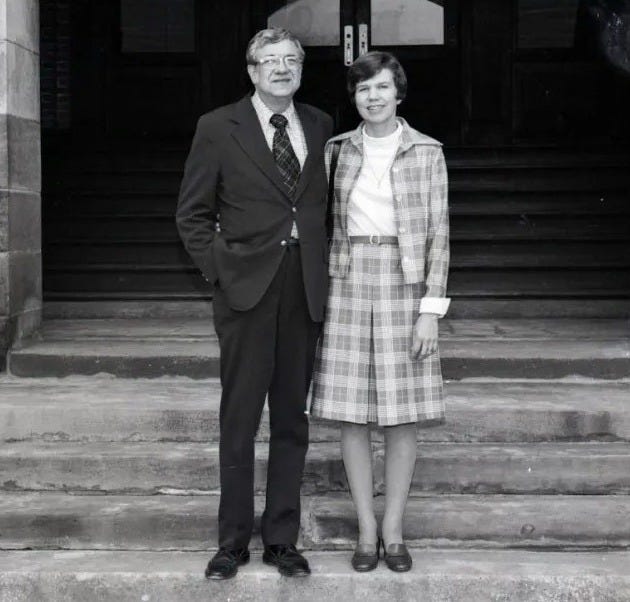
They would stay in West Virginia only one year. Ron decided that none of the things he had done as a college president in his first year drew from his talents and passions. So he resigned with nothing immediately available as a next position. I wrote to Ron when I heard that news, and he responded to me in a September 1977 letter. One phrase poignantly described his circumstance. “Now I am a teacher without a classroom, a preacher without a pulpit, and a writer without a study,” he said. He would go on to teach at two other United Methodist seminaries, Garrett-Evangelical and Iliff, where he continued to be a highly regarded teacher.
Hymn of Promise
In 1985, Natalie and Ron were living in Denver. It was at this time they learned that Ron was facing a battle with terminal cancer. Natalie tells of a friend coming to dinner during this time and sharing a work by T. S. Eliot in which there was a phrase, as she recalled, something like “in the end is our beginning.” That became the catalyst that led her to write “Hymn of Promise” over the next two days.
She and Ron were scheduled to go to Florida for a long-planned music festival built around Natalie’s music to be held at Pasadena Community Church in St. Petersburg, a United Methodist church. The director of choirs asked shortly before the event if Natalie had recently completed something that could be sung first during the festival. She offered “Hymn of Promise.” She knew immediately that the song touched people as she experienced their response to it.
Dr. C. Michael Hawn, University Distinguished Professor Emeritus of Church Music at Perkins, says that a “wonderful child-like simplicity permeates ‘Hymn of Promise.’” “Natalie Sleeth had a gift for composing texts on complex theological ideas that were still accessible to children,” he continued. “Her melodies seemed totally natural and therefore effortless for people to learn.” He notes that “Hymn of Promise “ is “one of the most memorable hymns written by an American United Methodist in the last part of the twentieth century, and it promises to be sung for many years to come.”
Within a month of their trip to Florida, Ron was nearing the end of his struggle with cancer. He asked Natalie for “Hymn of Promise” to be sung at his funeral. Ron died at 63 in 1985.
Natalie lived until 1992 when cancer ended her life at age 61.
Hawn tells of composer R. G. Huff attending Natalie’s funeral in Denver, though Huff had never met her. They had corresponded. Huff said, “I wanted to be there for the celebration of her contribution to church music, especially the music of children. For a full hour before the funeral, the church’s choir, soloists and organist performed her songs, hymns and anthems. It was a great tribute to her writing legacy.” Huff concluded that Natalie Sleeth “expressed how life moves into death, death gives way to eternity, and ultimate victory comes for those whose doubt has evolved into belief.”
United Methodists continue to be a singing people. And that will only be enhanced as new generations of diverse talented people of faith find that God has a calling for them to use their musical talents as a ministry, just as Natalie Sleeth and so many others have.
Sources
Natalie Sleeth, Adventures for the Soul (Carol Stream, IL: Hope Publishing Company, 1987). C. Michael Hawn, “History of Hymns: ‘In the Bulb There Is a Flower,’” Discipleship Ministries, September 12, 2013. “History of Hymns: ‘Praise the Lord with the Sound of Trumpet,’” Discipleship Ministries, August 31, 2023. Carlton R. Young, “Natalie Sleeth,” The Canterbury Dictionary of Hymnology. Canterbury Press.
Copyright holders: “Hymn of Promise” (Hope Publishing, 1986), ”Joy in the Morning” (Hope Publishing, 1977), “Jazz Gloria” (Carl Fischer, 1970), “Praise the Lord with the Sound of Trumpet,” (Hinshaw Music, 1976). Songs of Zion, Mil Voces Para Celebrar, and The Faith We Sing hymnals are published by Abingdon Press.
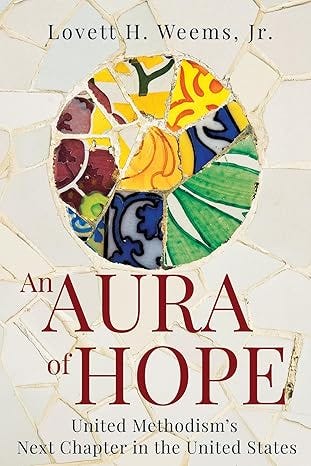
To purchase An Aura of Hope: United Methodism’s Next Chapter in the United States
Another good start to the morning provided by you my friend. Thanks.
Some theology reaches us through argument. Some reaches us because we have sung it enough times for the truth to remain when we need it.
That may be one of the great gifts of hymnody. A well-written hymn does more than describe Christian belief. It gives the Church language for grief, hope, surrender, holiness, and resurrection before we even know which words we will need.
There is a real responsibility here for Christian writers too: to create words worth carrying.