Church and State amid Christian Nationalism
A Place for Christians on This July 4

Will Campbell was a plain-spoken man. A Baptist pastor who grew up poor in southwest Mississippi, went to Yale Divinity School, was the only white person present at the formation of Martin Luther King, Jr.’s Southern Christian Leadership Conference, and had a ministry primarily among persons on the edge of conventional society. I, along with a grandson, visited his grave on a recent trip to Mississippi.
Campbell said once, “There are lies being told about the Bible and America by people who should know better, and probably do.” He had little use for those who function through organizations subsidized by tax exemptions and protected by the same First Amendment they frequently denounce. They “clothe a blatantly political agenda in pious rhetoric and peddle it as gospel.”
On one occasion, his target was a position familiar to many these days. He was decrying those who preach that “America was founded by right-wing Christians, who espoused the same theology as they [themselves] do.” Campbell points out that there were “no right-wing pietists in the motley crew that shaped America’s earliest documents.” They were not trying to establish a Christian nation. Quite the opposite. They were fleeing from entanglement with anybody’s religion. They knew what happens when church and state seek to use each other.
The Pentagon’s New Recognized Religions List
I thought of those incisive words when I read reports that the Department of Defense had updated its religious definitions, including slashing the list of recognized religious groups from 200 down to 30. Intense and immediate pressure led them to add under the Christian designation the Church of Jesus Christ of Latter-day Saints, commonly known as the Mormons. Several people referred to words in their church’s name in making their Christian claim.
Diana Butler Bass posted on Substack:
The Department of Defense put out its list of “approved” religions. Only 31 groups made the list. They excluded almost 200 others — including Unitarians and Deists. Taking those two off the list excludes almost every signer of the Declaration of Independence from the list of religions that “count” as truly American. (Substack Note, June 5, 2026)
The Pentagon’s action follows the Holy Week firing by the Secretary of Defense of the head of the Army Chaplain Corps, Major General William Green, without explanation. Green’s ordination is in the National Baptist Convention U.S.A. He is a graduate of United Methodist-related Candler School of Theology at Emory University. Green is the third Black chief of chaplains. He is the first chief of chaplains ever to be fired. In criticizing this action, Senator Chris Coons of Delaware, a graduate of Yale Divinity School, said that “General Green is a decorated leader who tended to our military’s spiritual health with honor and distinction.”
Mainline Participation in Civil Religion
A Baptist podcaster asked me recently if the United Methodist Church had a policy on the separation of church and state. I told him that we did but for a long time, we and many others had looked on Baptists as the gold standard for separation of church and state. For many Baptists, though no longer all, that statement is still true. The historical facts indicate that both Methodists and Baptists have mixed records on separation of church and state, partially depending on whether each was an insider or outsider to the larger society. The marginal fear interference. The powerful assume that they will be favored by public policies that touch on religion.
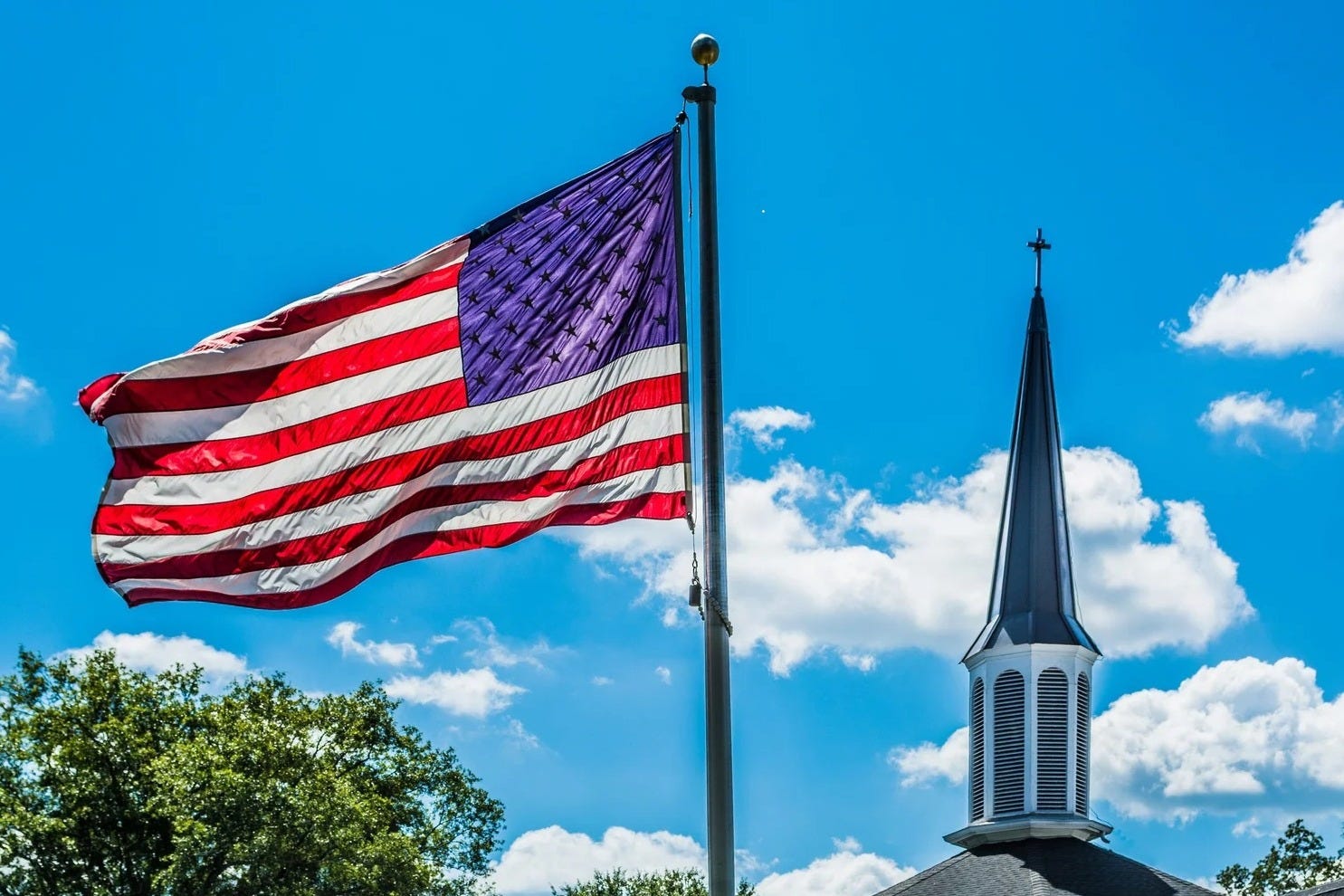
While we associate the linking of church and state, including Christian nationalism, with the most conservative expressions of Christianity today, few religious groups have clean hands. Many would argue with justification that Christian nationalism today is a harsher and more authoritarian expression of church-state complicity than that practiced by others in the past. But who knows the power of the so-called softer expressions through adding “under God” to the Pledge of Allegiance, adding “In God We Trust” to currency, prayers at public events, and American flags in churches? And who can tell the extent to which such acts paved the way for some of what we see today? Brian Kaylor and Beau Underwood have documented some of these ecumenical practices of civil religion in Baptizing America: How Mainline Protestants Helped Build Christian Nationalism.
United Methodists and Separation of Church and State
We know that the United Methodist predecessors got into the conversation between church and state quite early in the nation’s history. In fact, the first letter that George Washington wrote to a religious group was a reply to a letter he had received from “the bishops of the Methodist Episcopal Church.” Keep in mind that at that point in history, “the bishops” were two in number, Francis Asbury and Thomas Coke. Their letter to the new president offered congratulations, appreciation for his expressed dependence on “the Great Governor of the Universe,” their confidence in Washington to protect “those civil and religious liberties which have been transmitted to us by the providence of God and the glorious revolution,” and assurances of their prayers. Washington’s reply was gracious with thanks for their good wishes and prayers. He included that he desired to “contribute whatever may be in my power towards the preservation of the civil and religious liberties of the American People.”
Things had changed much by the time Abraham Lincoln was president. Methodism had grown from one of the smallest religious groups in the nation to become the largest, well larger than any other. In 1866 Harper’s Weekly would call Methodists “the predominant ecclesiastical fact of the nation.” Just prior to the 1864 General Conference, a group of Methodists visited the president, alerting him the day before and sending their written message. President Lincoln saw them the next day and presented them with a letter. “While all churches are important,” Lincoln wrote, “it may fairly be said that the Methodist Episcopal Church … is the most important of all.” Bishop Matthew Simpson would speak at Lincoln’s burial. Methodism had come a long way.
Social location has always made important differences in how religious groups approach separation of church and state. A recent religious event in Washington as part of the 250th anniversary of the nation did not include a single religious leader from a mainline denomination. In the 1950s, such an event probably would have included only leaders from mainline denominations. Access to power can make people feel good, but history tells us that there are dangers in such proximity. As Martin Luther King, Jr., put it once, “The church must be reminded that it is not the master or the servant of the state, but rather the conscience of the state. It must be the guide and critic of the state, and never its tool.”
United Methodists and Today’s Context
The current Social Principles of the United Methodist Church, now written with a global context in mind, carry important affirmations regarding both separation of church and state and the rights of all religious faiths to worship freely and without governmental discrimination. Some passages include:
We affirm that both church and state have vital and distinct roles to play in relation to the larger society…. We advocate for a relationship of mutual respect in which neither institution seeks to dominate nor unduly influence the other.
While we do not believe churches should affiliate with particular political parties, we do encourage churches to speak out boldly on social issues from a Gospel perspective. (Government Responsibilities: Church and Governance)
We affirm the rights of religious minorities to worship in peace and to exercise their faith free from fear of discrimination or persecution. We condemn actions by any individual, group or organization that denigrate or demean those belonging to another faith. (Basic Rights and Freedoms: Religious Minorities)
The Council of Bishops has provided a study resource to help the church understand the dangers of authoritarianism and Christian nationalism, Building Beloved Community: The Courage to Love in the Face of Tyranny. “Building beloved community,” they say, “amid the rise of authoritarian movements is the challenge that faces us in this hour.”
Our July 4 Challenge
As the nation remembers its 250th anniversary, it is a good time to remember that Methodists shared all those years, plus more, with the people of this nation. Both church and nation can look back with stellar examples of faithfulness to the originating values of both church and state. Both also remember with humility when we have fallen short of those ideals.
As we live among authoritarian and Christian nationalism forces today, one of the most important things for United Methodists to understand is that when leaders use religious language, it may well have nothing to do with allegiance to the faith embodied in Jesus Christ. Nor do we know if it is connected to true patriotism. A common practice of nationalism and authoritarianism is to use religious categories to mask goals of power and control.
True patriots and faithful followers of Jesus harbor no ill wishes toward those of other religions and races, nor wish harm for other nations. The harsh language used today to play on group resentment is antithetical to everything the Christian faith represents.
So let us encourage one another to celebrate July 4 this year with humility, thanksgiving, and a large measure of Christian compassion.
References
Will Campbell quotations. Will D. Campbell, Soul Among Lions: Musings of a Bootleg Preacher (Louisville, KY: Westminster John Knox Press, 1999), 19.
Letters between Methodist Episcopal bishops and George Washington. W. W. Abbot, ed., The Papers of George Washington, Volume 2 (Charlottesville, VA: University Press of Virginia, 1987), 411-412.
Harper’s Weekly reference. Quoted in Jean Miller Schmidt, “Reexamining the Public/Private Split: Reforming the Continent and Spreading Scriptural Holiness,” in Perspectives on American Methodism: Interpretive Essays, eds. Russell B. Richey, Kenneth E. Rowe, and Jean Miller Schmidt (Nashville: Kingswood, 1993), 233.
Lincoln letter to the visiting Methodists. George R. Crooks, The Life of Bishop Matthew Simpson (New York: Harper and Bros., 1891), 395ff.
Martin Luther King, Jr.’s quotation. Cited in Randall Balmer, Saving Faith: How American Christianity Can Reclaim Its Prophetic Voice (Minneapolis: Fortress Press, 2023), 78.
To purchase An Aura of Hope: United Methodism’s Next Chapter in the United States