
Learning from United Methodism’s First Day in 1968
Welcome to the United Methodist Focus newsletter.

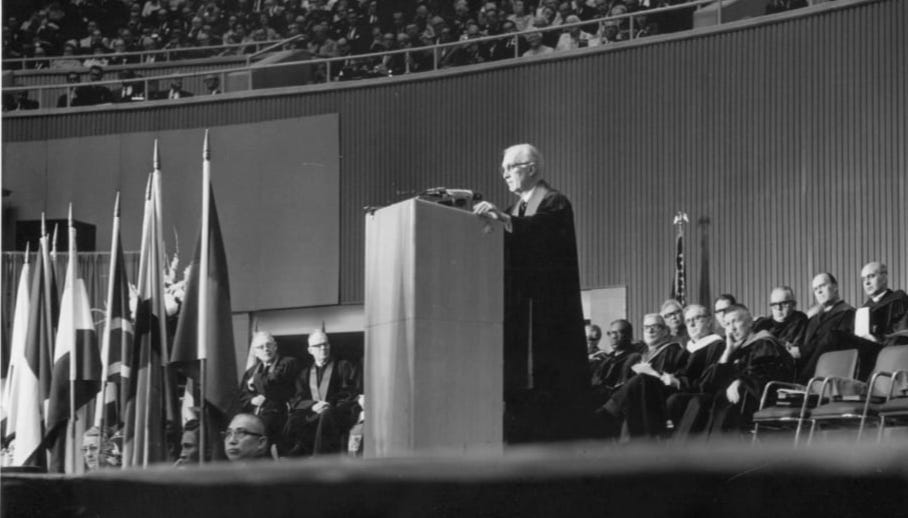
Today it is common for United Methodists to talk about the “new United Methodist Church,” anticipating a new era in the denomination’s pilgrimage. Disaffiliation struggles between 2019 and 2023 saw a quarter of United Methodist churches choose to leave the denomination. In addition to the tragedy of disaffiliation, the disaster of the COVID-19 pandemic took place at the same time. Further complicating church life was an accelerating withdrawal of active religious participation across virtually all traditions in the United States. So, it is appropriate for United Methodists to hope for a “new beginning” after years of challenge.
It may be helpful to remember the original beginning of the United Methodist Church on April 23, 1968, when the newly formed union of The Methodist Church and the Evangelical United Brethren Church began with a worship service marking unification. The preacher for that service was Professor Albert C. Outler from Perkins School of Theology. Outler was a logical choice as one of the preeminent scholars of 20th century Methodism. He and a relatively small group of others had brought the study of John Wesley and Wesleyan theology to a new place of regard and research that spawned an era of Wesleyan scholarly energy and productivity.
It was from Professor Outler’s sermon that I drew the title of my newly published book, An Aura of Hope: United Methodism’s Next Chapter in the United States (Abingdon Press). It appeared to me that these words from his message also fit our time: “The aura of every newborn thing is an aura of hope. And so it is with us today. We stand here on a threshold. A new horizon looms ahead.” Indeed, we now face such a moment as we seek to renew and revive after momentous struggles.
It was in 1968 that I first came to know Dr. Outler when I was a student at Perkins. His friendship over his lifetime was a blessing to my life and a guide for my thinking. Some of the concepts I learned from him that can serve us well in this new chapter include:
Evangelism and action are inextricably joined. “The world hears the Gospel when it sees it when its witnesses are clearly concerned with human existence and clearly committed to a more fully human future, in this world and the next.”
Wesley had a special passion for the poor. Outler said he could not name “another Englishman of his century” who so heartily identified with the English poor or whose identification was more heartily accepted by them.
Wesley’s followers were to be a “band of martyrs and servants,” emptying and giving themselves freely for others in “visible martyrdom and servanthood.”
Wesley’s theology provides “third alternatives” to “barren polarities generated by centuries of polemics.” His task was not discovering new truths. It was looking at existing truths with a more open and integrative perspective. He was a “synthesizer of a rich, multifaceted tradition.”
And, perhaps most important of all, Outler understood that Wesley’s high regard for tradition did not prevent him from being free to update his own complex heritage.
On that day of celebration in 1968, Outler was clear that the future held challenges. “The church is in radical crisis, and in the throes of a profound demoralization,” he said. He reminded everyone that Methodism’s golden age had faded, and any new world will require a new generation of frontier people to be as dynamically adaptive to their new world as our forebears were in theirs. Indeed, that is once again the challenge of the moment.
For more information:
Albert Outler’s handwritten edits of the sermon
To purchase An Aura of Hope: United Methodism’s Next Chapter in the United States
This is great! Excited to read more.
Thank you so much for sharing your wisdom with us in this series. I am looking forward to learning from you as I follow it.